
Western Desert Oases Road Trip: Bahariya, Farafra, Dakhla and Kharga Route Guide (2026)
 Local insight by Eyad Elzaghandi
12 min read
A Western Desert oases road trip links four oases in a loop of roughly 1,000 km: Cairo to Bahariya (about 330 to 370 km), then through the Black Desert and the White Desert to Farafra (about 185 km), on to Dakhla (about 200 km) and Kharga (about 190 km), and finally to Luxor on the Nile or back to Cairo via Asyut. Plan 6 to 8 days to see the highlights without rushing, travel between October and April, and go with a licensed operator who handles checkpoints and desert permits.
- Loop lengthAbout 1,000 km
- Days6 to 8
- OasesBahariya, Farafra, Dakhla, Kharga
- Best monthsOctober to April
In this guide
- The route at a glance
- Why do the loop
- Bahariya Oasis
- Black Desert, Crystal Mountain and the White Desert
- Farafra Oasis
- Dakhla Oasis
- Kharga Oasis
- A 7 day itinerary
- Shorter versions
- Checkpoints, permits and security
- Self drive or guided
- Fuel, phones and services
- Where to stay
- Hot springs along the way
- Best time to go
- What to pack
- Oasis culture and etiquette
- Food on the road
- Common mistakes
- What about Siwa
- Detours worth adding
- A short history of the oases
- What affects the cost
- Clockwise or anticlockwise
- Drive it with locals
- Western Desert oases road trip in one minute
- Western Desert oases road trip FAQ
The route at a glance
The oases sit in a chain of depressions in the Western Desert, linked by good paved roads. Distances are approximate and driving times exclude stops.
| Leg | Distance | Drive | Highlights |
|---|---|---|---|
| Cairo to Bahariya | About 330 to 370 km | 4 to 5 hours | Desert highway, Bawiti town |
| Bahariya to White Desert | About 120 to 150 km | 1.5 to 2 hours | Black Desert, Crystal Mountain, Agabat |
| White Desert to Farafra | About 45 km | Under 1 hour | Qasr al Farafra, hot spring |
| Farafra to Dakhla | About 200 km | 2.5 to 3 hours | Sand dunes, Al Qasr old town |
| Dakhla to Kharga | About 190 km | 2.5 hours | Balat, desert plateau |
| Kharga to Luxor | About 230 to 250 km | 3 to 4 hours | New road across the plateau |
| Kharga to Asyut | About 235 km | 3 to 4 hours | Escarpment road to the Nile |
Distances vary by source and route. Confirm current road conditions before travel.
Why do the loop
Most visitors to Egypt only see the Nile. The oases show a different country: palm gardens fed by springs, mud brick villages, Roman forts, Christian chapels, hot pools under the stars and some of the most surreal desert landscapes on earth. Distances are long but roads are good, traffic is light and people are famously welcoming.
Bahariya Oasis
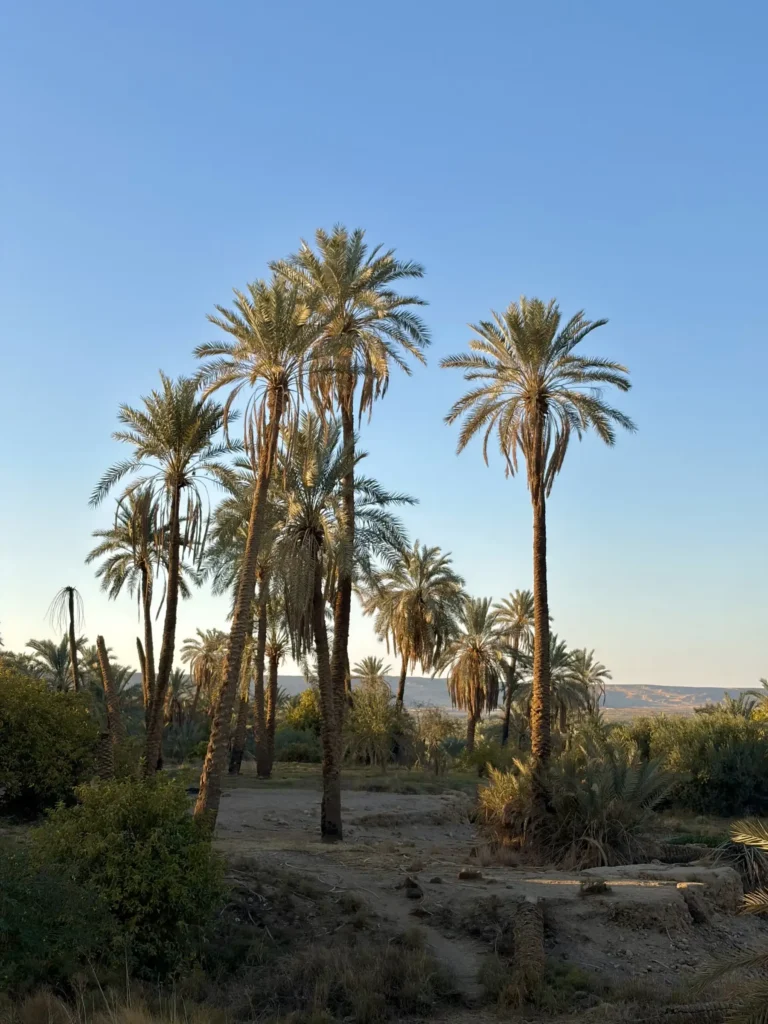
The first oasis, closest to Cairo, and our home. Bawiti, the main town, sits above palm gardens and springs. Here you can visit Late Period tombs, the Temple of Alexander the Great and the museum of the Golden Mummies, soak in hot springs and climb the English Mountain for views. Read our Bahariya Oasis guide and Valley of the Golden Mummies.
Black Desert, Crystal Mountain and the White Desert
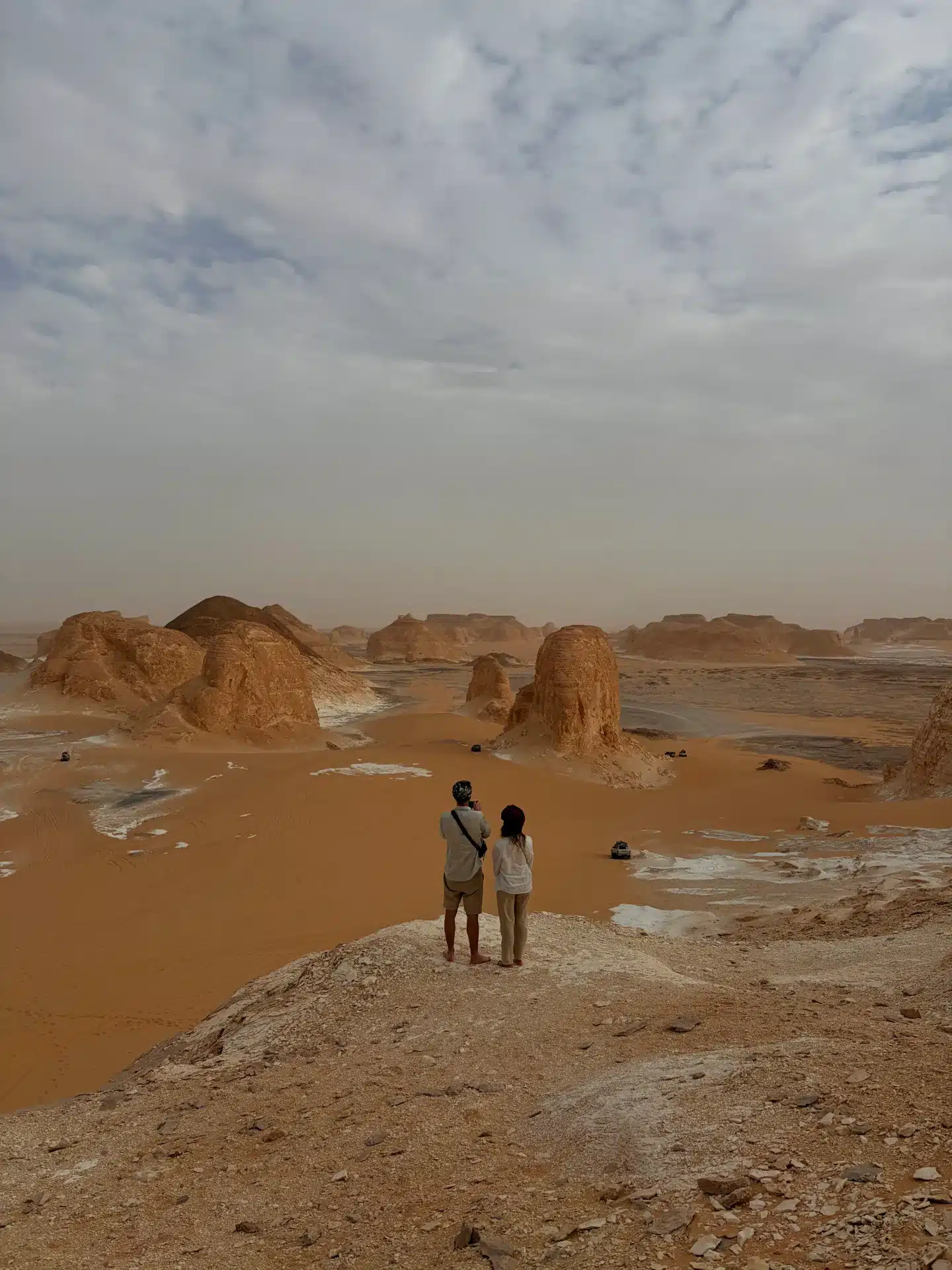
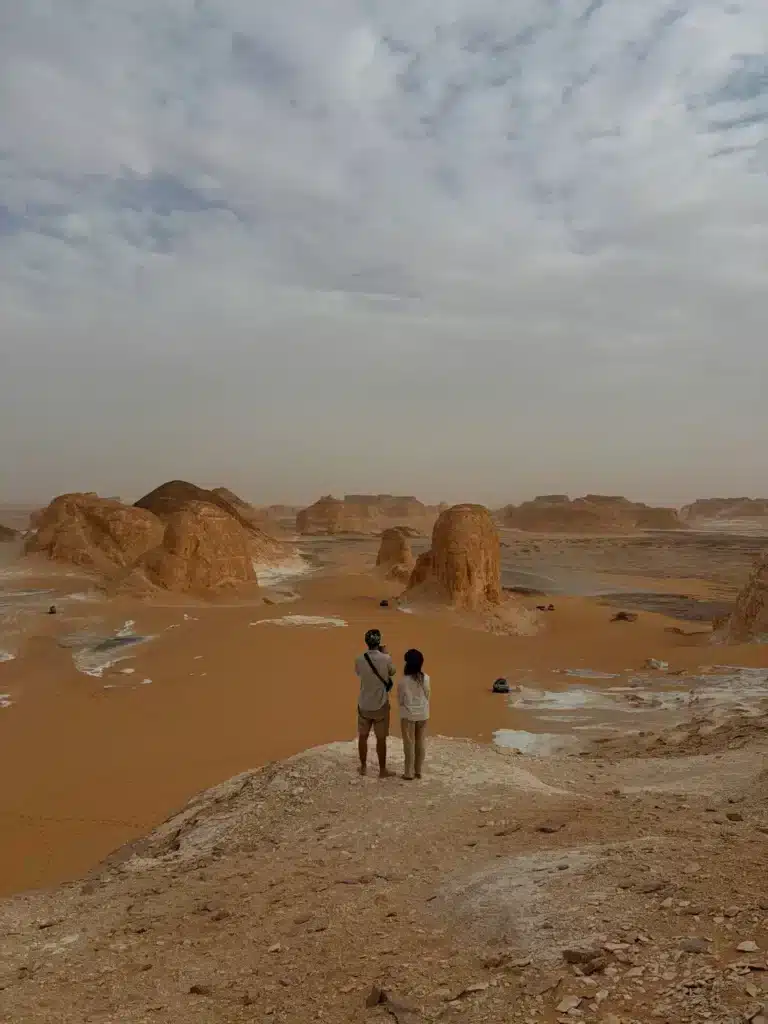
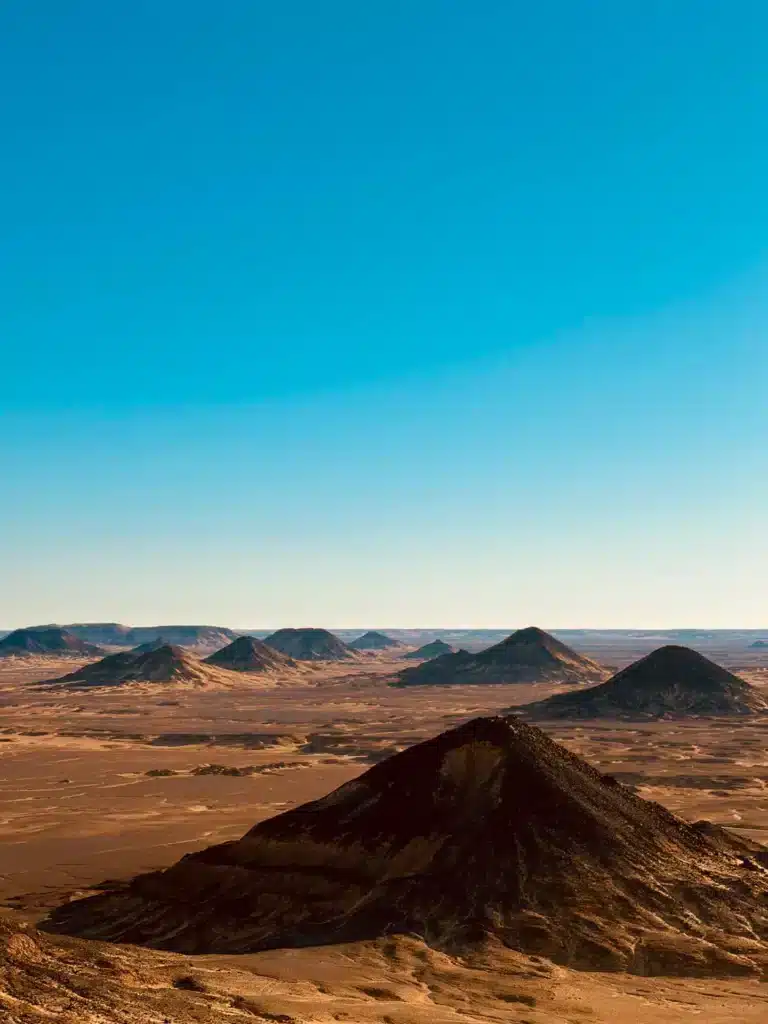
South of Bahariya the road crosses the most spectacular stretch of the loop. First the golden hills covered in black stones of the Black Desert, then the quartz ridge of Crystal Mountain, the towers of Agabat and finally the chalk sculptures of the White Desert. Spend the night camping here, it is the highlight of the whole trip.
Farafra Oasis
The smallest and quietest of the four. Qasr al Farafra is a village of mud brick houses and gardens, with more than 100 springs in the depression. Bir Sitta, a hot spring a few kilometres from town, is perfect for a soak after a desert night. A local artist’s gallery shows sculptures and paintings inspired by oasis life.
| Sight | Why go |
|---|---|
| Qasr al Farafra | Old mud brick village and palm gardens |
| Bir Sitta hot spring | Warm spring water in the fields |
| Local art gallery | Sculptures and paintings of oasis life |
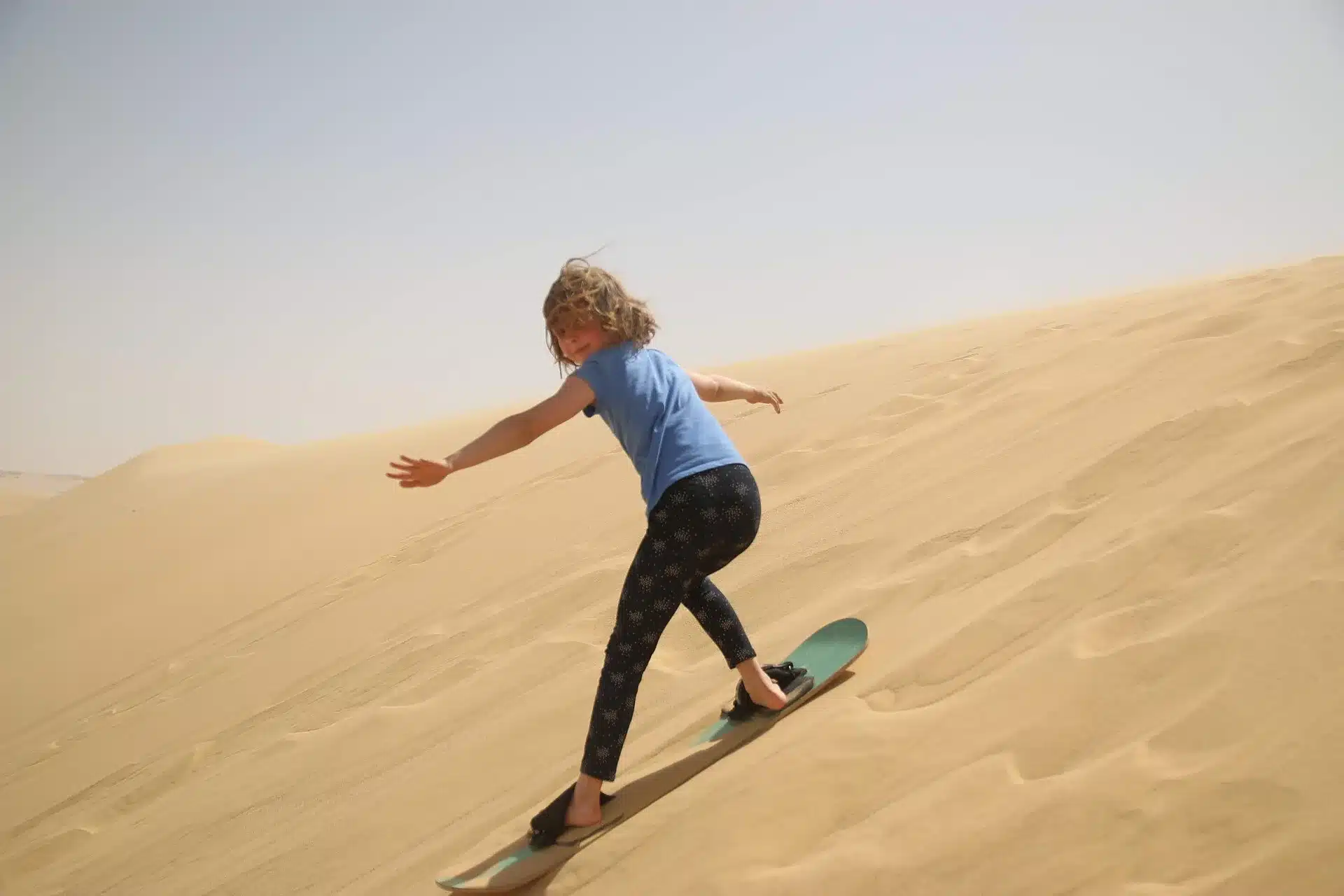
| Sand dunes | Easy dunes for sandboarding |
Dakhla Oasis
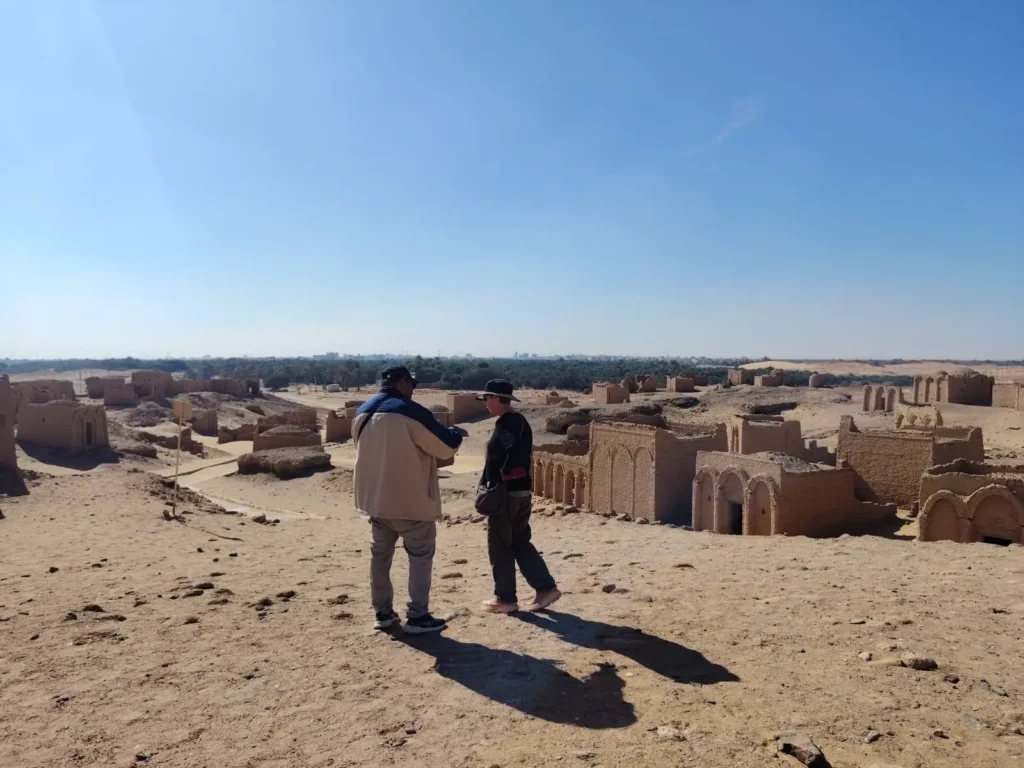
Dakhla is green and fertile, with hundreds of springs feeding fields of dates, olives, citrus and rice. Its jewel is Al Qasr, a medieval Islamic town of narrow covered alleys, carved wooden lintels, an old mosque and a tall minaret. Nearby are the Roman temple of Deir al Hagar, the Old Kingdom site of Balat and the hilltop tombs of Al Muzawwaqa. Mut is the main town with hotels.


| Sight | Period | Why go |
|---|---|---|
| Al Qasr old town | Medieval Islamic | Covered alleys, carved doors, minaret |
| Deir al Hagar | Roman | Sandstone temple in the desert |
| Balat | Old Kingdom | Governors’ tombs and mastabas |
| Al Muzawwaqa | Roman | Painted tombs on a hill |
| Mut | Modern | Hotels, food, services |
Kharga Oasis
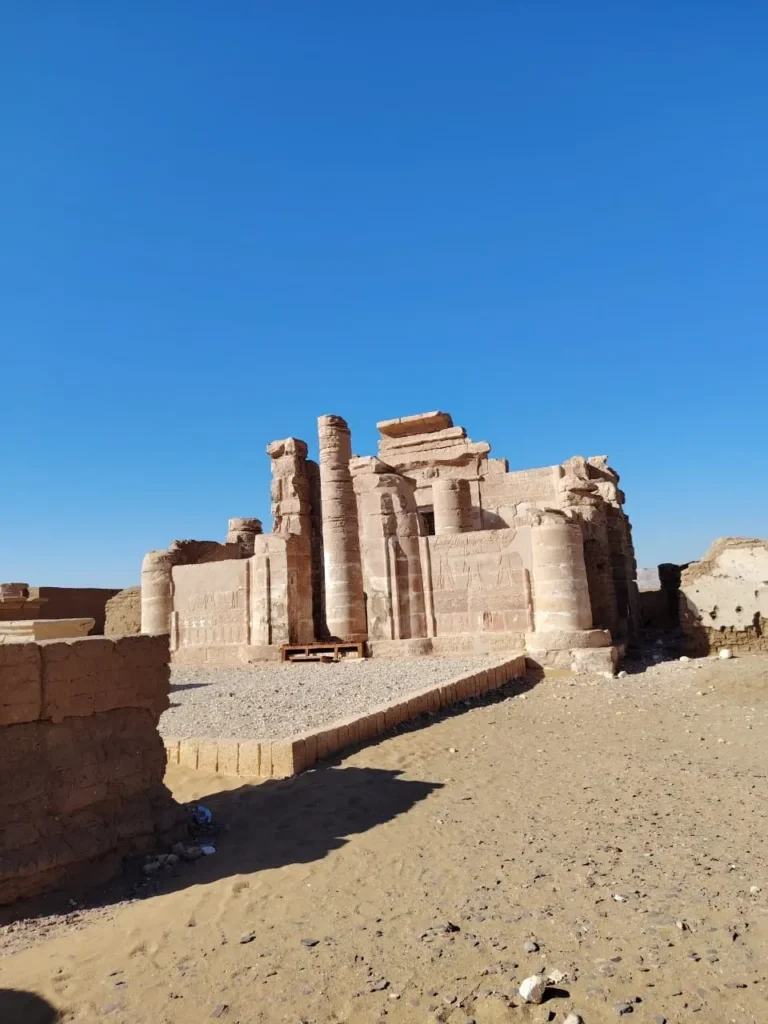
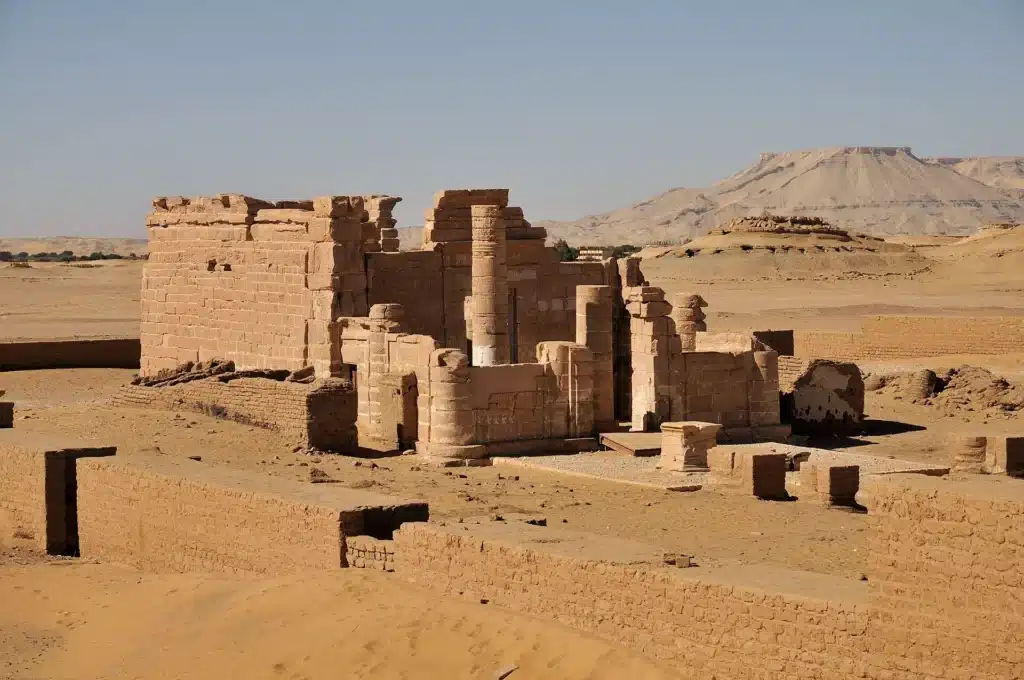
Kharga is the largest oasis and capital of New Valley Governorate. Its history is rich. The Temple of Hibis, dedicated to Amun, dates to the Saite and Persian periods. On a hill nearby, the Christian necropolis of Al Bagawat holds more than 260 mud brick funerary chapels, some with painted domes from the early Christian centuries. South of town, Roman forts and temples like Qasr al Ghueita and Qasr al Zayyan guard ancient caravan routes, and Qasr Dush stands further south near Baris.


| Sight | Period | Why go |
|---|---|---|
| Temple of Hibis | Saite to Persian | Rare temple from the Persian era |
| Al Bagawat | Early Christian | One of the oldest Christian cemeteries |
| Qasr al Ghueita | Ptolemaic and Roman | Hilltop temple and fort |
| Qasr al Zayyan | Roman | Temple of Amun of Hibis |
| Qasr Dush | Roman | Temple and fort far south |
A 7 day itinerary
This plan follows the loop clockwise and ends in Luxor, so you can continue on the Nile.
| Day | Route | Night |
|---|---|---|
| 1 | Cairo to Bahariya, oasis sights, hot spring | Bahariya |
| 2 | Black Desert, Crystal Mountain, Agabat, White Desert | Camp in the White Desert |
| 3 | Sunrise, Farafra village and Bir Sitta, drive to Dakhla | Dakhla |
| 4 | Al Qasr, Deir al Hagar, Al Muzawwaqa | Dakhla |
| 5 | Balat, drive to Kharga, Temple of Hibis | Kharga |
| 6 | Al Bagawat, Qasr al Ghueita, Qasr al Zayyan | Kharga |
| 7 | Drive to Luxor | Luxor |
Shorter versions
Not everyone has a week. These shorter plans keep the best parts.
| Time | Route | Good for |
|---|---|---|
| 1 day | Cairo to Bahariya and the White Desert, back the same day | A taste, very long day |
| 2 days | Bahariya and a night in the White Desert | The classic |
| 3 days | Add the Old White Desert or Djara Cave | More desert, fewer crowds |
| 4 days | Bahariya, White Desert, Farafra | Quiet oasis life |
| 5 to 6 days | Add Dakhla, return via Bahariya or continue | Al Qasr and the south |
See the White Desert day trip, the 2 day tour and the 3 day tour.
Checkpoints, permits and security
Police checkpoints sit at the entrances of each oasis and on the roads between them. They register passports and sometimes ask for your route. Licensed tour operators prepare the paperwork in advance, and some areas off the main road, such as the deep desert towards the Great Sand Sea or Gilf Kebir, need special permits and can only be visited with a registered company. Travel rules can change, so always check your government’s travel advice and ask your operator for current requirements.
- Passport with your Egypt visa, and copies.
- Travel route shared with your operator.
- Permits arranged by the operator for off road areas.
- Travel insurance that covers remote areas.
Self drive or guided
The paved road is easy to drive, and some independent travelers rent a car. But the real highlights, the White Desert camp, the Old White Desert, Djara Cave and the dunes, are off road and need a 4×4, desert driving skills and permits. Most visitors choose a guided trip for the desert sections and a driver for the long paved legs. A guide also explains the history and opens doors in the villages.
| Option | Pros | Cons |
|---|---|---|
| Self drive | Freedom, own pace | No off road access, checkpoints harder, long empty stretches |
| Driver only | Comfort, local knowledge of roads | No deep desert or explanations |
| Guided with 4×4 | Desert camps, permits, history, safety | Less spontaneous |
Fuel, phones and services
Petrol stations are in each oasis town, but stretches between them are long and empty. Fill up whenever you can. Mobile signal is good in towns and weak or absent in much of the open desert. ATMs exist in the main towns, but carry enough cash. Basic clinics and pharmacies are in Bawiti, Mut and Kharga.
| Service | Where | Tip |
|---|---|---|
| Fuel | Bawiti, Farafra, Mut, Kharga | Never pass a station with half a tank |
| Mobile signal | Towns and main roads near them | Download offline maps |
| ATMs | Main towns | Carry cash for small villages |
| Medical | Clinics in main towns | Bring a basic first aid kit |
| Food | Towns and roadside cafes | Carry water and snacks |
Where to stay
Each oasis has simple hotels and eco lodges built in mud brick, plus camps in the desert. Bahariya has the most choice. Read where to stay in Bahariya Oasis and our Bahariya eco lodge guide.
Hot springs along the way
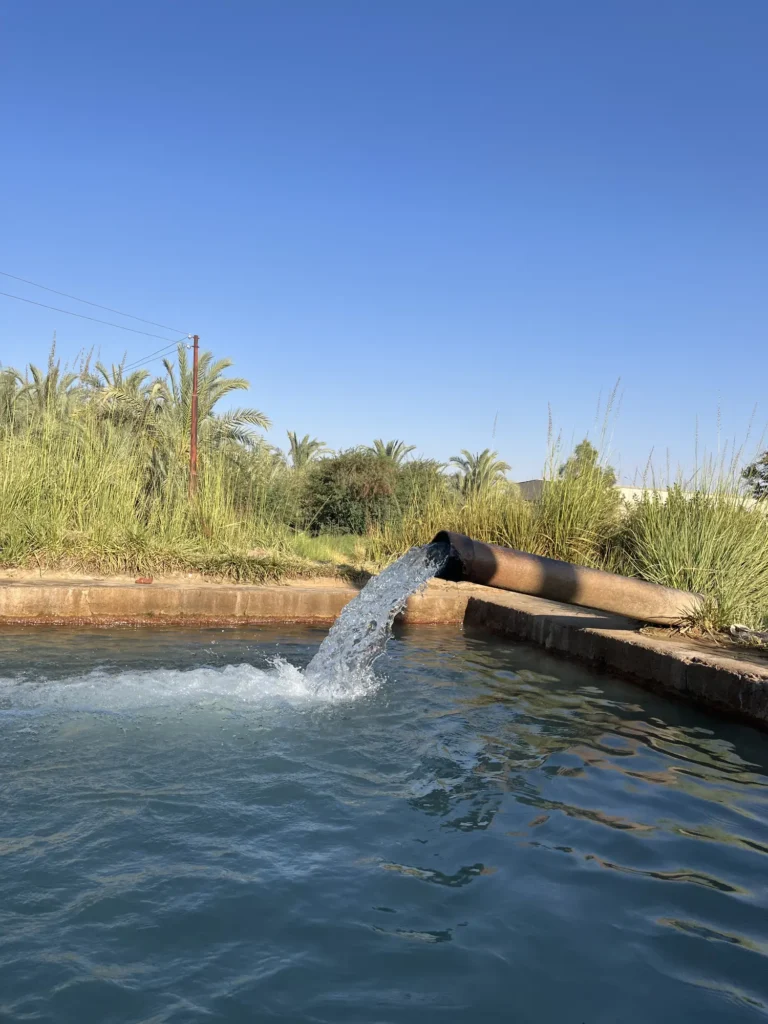
The oases are fed by ancient groundwater, much of it warm. Soaking in a spring after a dusty day is one of the joys of the loop. Bahariya has several springs around Bawiti, Farafra has Bir Sitta and Dakhla has warm wells in the fields. Read our Bahariya hot springs guide.
Best time to go
October to April is ideal, with warm days and cool to cold nights in the desert. Summer brings temperatures above 40°C in the south, so driving and visits shift to early morning. Spring can bring sand winds.
| Season | Days | Nights | Advice |
|---|---|---|---|
| October to November | Warm | Mild | Excellent |
| December to February | Mild | Cold in the desert | Pack warm layers |
| March to April | Warm to hot | Mild | Watch for sand winds |
| May to September | Very hot | Warm | Early starts only |
What to pack
- Warm jacket, hat and gloves for desert nights in winter.
- Light long sleeves, sun hat and sunglasses for the day.
- Swimwear for hot springs.
- Scarf for dust and for visiting villages.
- Headlamp, power bank and offline maps.
- Passport copies and cash.
See our full desert packing list.
Oasis culture and etiquette
Oasis communities are conservative and very hospitable. Dress modestly in villages, ask before photographing people, accept tea when offered and use your right hand to eat and give. In Ramadan, avoid eating in public during the day. A few words of Arabic go a long way.

Food on the road
Expect fresh dates, olives, oasis rice, slow cooked chicken, lentil soup and bread baked in the sand on desert nights. Each oasis has its own date varieties. Buy a bag in Bahariya or Dakhla as a sweet souvenir.

Common mistakes
Learn from what we see every season.
| Mistake | Better choice |
|---|---|
| Too many kilometres per day | Keep long drives under 5 hours |
| Skipping the White Desert night | Camp there, it is the highlight |
| Driving after dark | Arrive before sunset |
| No warm clothes | Pack for near freezing winter nights |
| Ignoring permits | Use a licensed operator |
What about Siwa
Siwa is also in the Western Desert but sits far to the northwest, near the Libyan border, and is not on the loop. It is usually visited from Marsa Matruh or on a separate trip. A few expeditions cross from Bahariya to Siwa through the desert with permits. Compare them in Bahariya vs Siwa.
Detours worth adding
With an extra day, add the stalactite cave of Djara between Bahariya and Farafra, or the dunes of the Great Sand Sea on the edge of the loop. Both need 4×4 and permits. Read Djara Cave and the Great Sand Sea, or see the Djara Cave tour.
A short history of the oases
The oases have been inhabited since prehistoric times, when the Sahara was green. Under the pharaohs they were outposts that supplied wine, dates and minerals and guarded the western borders. Greeks and Romans built temples and forts along caravan routes, early Christians found refuge in Kharga, and medieval towns like Al Qasr grew on trade between Africa and the Nile. In the 20th century the state launched the New Valley project to bring new farms and towns to the desert.

What affects the cost
Costs depend on the number of days, hotel or camp level, private or shared transport, 4×4 days in the desert, guide, entry tickets and permits. We do not list fixed prices here because they change by season and group size. Read White Desert tour cost for the desert part, or ask us for a quote.
Clockwise or anticlockwise
You can start in Luxor and drive north to Kharga, Dakhla, Farafra and Bahariya, ending in Cairo. Both directions work. Starting in Cairo puts the White Desert early, when you have energy, while starting in Luxor ends the trip with the desert and Cairo’s flights.
Drive it with locals
We were born in Bahariya and drive these roads every week. We plan the loop around the light, the checkpoints and your pace, with 4x4s for the desert and comfortable cars for the long paved legs.
Western Desert oases road trip in one minute
- The loop links Bahariya, Farafra, Dakhla and Kharga, about 1,000 km.
- Camp in the White Desert between Bahariya and Farafra.
- Dakhla has the medieval town of Al Qasr, Kharga has Hibis and Al Bagawat.
- Plan 6 to 8 days and end in Luxor or return to Cairo.
- Use a licensed operator for checkpoints and off road areas.
Western Desert oases road trip FAQ
How long is the Western Desert oases loop
About 1,000 km from Cairo through the four oases to Luxor or back to Cairo.
How many days do I need
6 to 8 days to see the highlights calmly.
Can I end the trip in Luxor
Yes, a road links Kharga with Luxor.
Is the oases road safe
The main road is used daily and has checkpoints. Check your government’s advice and use a licensed operator.
Do I need a permit
Main roads need only your passport at checkpoints. Off road and deep desert areas need permits arranged by an operator.
Can I self drive
Yes on paved roads, but desert camps and off road areas need a 4×4 and a local team.
Which oasis is the most beautiful
Many travelers love Dakhla’s Al Qasr, but the White Desert near Farafra is the highlight.
When is the best time
October to April.
Official sources and further reading
- Britannica: Western Desert of Egypt
- Britannica: Bahariya Oasis
- Experience Egypt: official Egypt tourism site
- Ministry of Tourism and Antiquities: Egypt monuments
- GOV.UK: Egypt travel advice
- Lonely Planet: Egypt travel guide
- Eyad Elzaghandi, author of this guide, founder of Egypt Desert Trips and licensed local guide: 5.0 on Tripadvisor from 43 traveler reviews

Eyad Elzaghandi wrote this guide. He is the founder of Egypt Desert Trips, a licensed tour guide born in Bahariya Oasis and the organiser of every trip on this site. With a team of local guides and drivers he hosts travelers across the Western Desert, Cairo, the Nile Valley and Sinai. Travelers rate his tours 5.0 on Tripadvisor from 43 reviews, listed as Elzaghandi Travel. Meet the team.
Keep planning
Planning your own Egypt journey?
Tell us your dates, interests and travel style. Eyad and the Egypt Desert Trips team will help shape a private journey around the Egypt you want to experience.
Sandboarding in Fayoum 2026: Best Dunes, Prices and Beginner Guide
Everything you need for sandboarding in Fayoum: the best dunes around Magic Lake and Wadi El Rayan, how a day…
Read Guide
Siwa Oasis Tour Cost from Cairo: Real 2026 Prices by Group Size
Real Siwa Oasis tour prices from Cairo for 2026: 3, 4 and 5 day private tours by group size, what…
Read Guide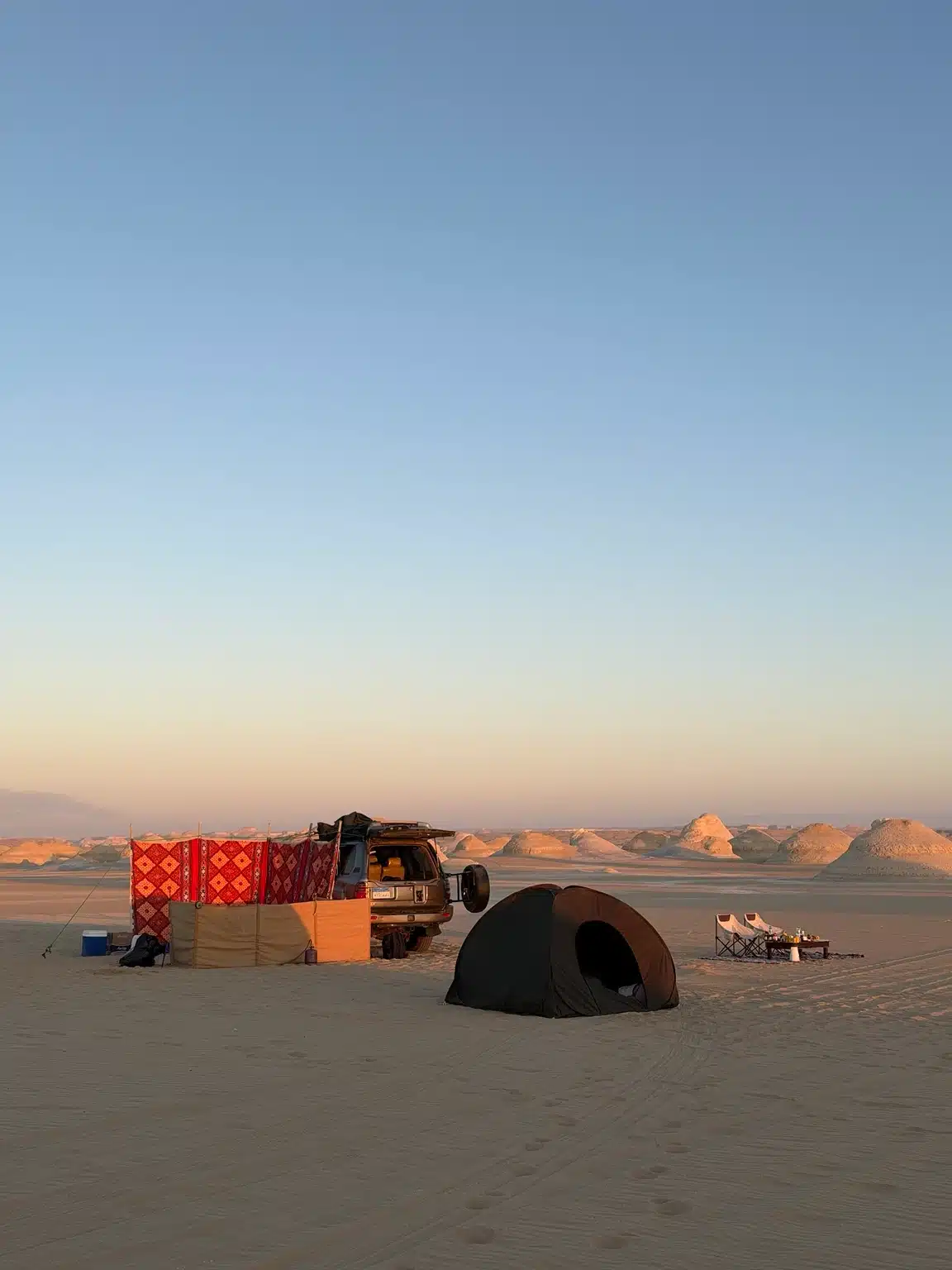
White Desert Tour from Hurghada or Luxor: Routes, Times and Best Options (2026)
How to visit the White Desert from Hurghada, Luxor, Sharm or Alexandria: driving times, flights via Cairo, private pickup from…
Read Guide